Hynautic
MECHANICAL STEERING | HYDRAULIC STEERING
MECHANICAL ENGINE CONTROLS | HYDRAULIC ENGINE CONTROLS
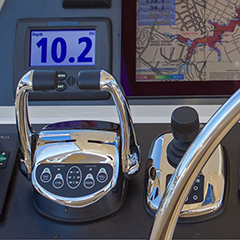
Hynautic hydraulic engine controls offer the boat owner a very positive, synchronized method of relaying multi-station remote commands to the engine's throttle and transmission linkages.
Engine controls have been packaged into systems for complete and simple installation. Systems have been designed for up to three stations, using either nylon tubing or copper tubing. Nylon tubing is preferred because of ease of installation and the material's expansion characteristics.
The slave unit is designed to deliver up to 120 inch pounds of torque through 80 degrees of travel. Therefore, a system will accommodate marine engines and hydraulic transmissions used on most boats to 100 feet. These systems have also been adapted for operating bow thrusters and variable pitch propellers.
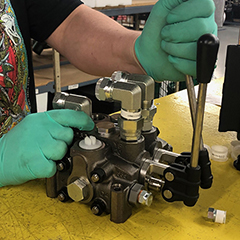
When the control handle of the Sending Unit is moved, mechanical energy is transformed into fluid energy by means of a rack and pinion attached to an internal piston. This piston expels fluid from the sending unit into all other control heads and the slave unit. The pistons in each of these units are thus moved an equal distance, causing a corresponding movement in the lever arm of each.
To control synchronization, the piston in each sender and slave contains two small valves. These are opened when the piston reaches the end of the stroke, allowing excess fluid to pass through the piston and into the system. Controls can be synchronized, if necessary, by rotating the lever arm of any control head from stop-to-stop.
The Reservoir maintains the extra fluid and a constant pressure head (80 psi) for the system. The flow of fluid to and from the reservoir is regulated by the Charging Valve. As fluid expands due to engine temperatures, the excess liquid is expelled into the reservoir at a controlled rate. Likewise, fluid is returned to the system as temperatures drop.
Each Throttle Slave Unit contains an over-travel bungee in its linkage to the engine. This device assures that the slave piston will reach end stroke in each direction. Otherwise, the balance between senders and slave cannot be maintained. The transmission slave unit has a mechanical detent to indicate a neutral position. Each throttle slave is equipped with an external pilot check valve which prevents control arms from drifting back to an idle position.
Hynautic Engine Controls are easily adapted to 5/16" unplasticized nylon tubing. This tubing expands at a similar rate as the fluid, thus compensating for inevitable fluid expansion and contraction. The tubing is easy to install and special O-ring fittings are supplied with each System. Bleeding the System of air is accomplished in a manner similar to an automobile's brake system. Special patented bleeder fittings are provided. Systems for copper tube plumbing are also available.
|